

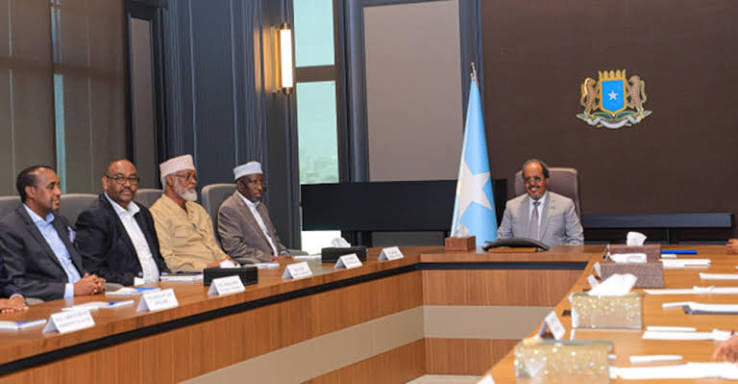
Somalia is approaching a dangerous political and security crossroads. A confrontation over constitutional amendments, presidential tenure, and elections is increasingly intersecting with competition among foreign powers for influence across the Horn of Africa, the Gulf of Aden, and the Red Sea. The danger is not simply that external governments back opposing Somali actors. It is that foreign rivalries can supply the resources, diplomatic protection, and military assistance that allow an unresolved domestic crisis to harden into a prolonged, multi-sided conflict.
In an analysis published on 16 October 2026, Chatham House argues that Somalia’s instability is being compounded by sharpened regional rivalries. It identifies Turkey and the United Arab Emirates (UAE) as particularly consequential actors within wider alignments involving Egypt, Saudi Arabia, Eritrea, Israel, and Ethiopia.
The timing matters. In the final days of October 2026, the United Nations political mission is closing after a ceremony in Mogadishu on 26 October, the electoral commission has fixed a contested 2027 election calendar, and the president has invited opposition groups to a national forum from 14 to 18 November that major opposition coalitions have not yet agreed to attend. The issue is therefore larger than a quarrel between Mogadishu and its opponents: Somalia’s divisions are entangled with the calculations of states seeking ports, maritime routes, military partnerships, and influence.
A distinction is essential. Foreign competition does not automatically produce war, and external governments are not the sole authors of Somalia’s instability; Somali elites retain agency and responsibility. The more immediate danger lies in the interaction between political exclusion, weak dispute-resolution mechanisms, fragmented security institutions, and foreign relationships that can shift the balance among factions. The question is whether Somalia’s leaders and partners can stop these overlapping interests from turning a constitutional dispute into a conflict that is hard to contain.
Constitutional Dispute: Domestic fault line beneath foreign competition
On 8 March 2026, President Hassan Sheikh Mohamud signed into law a constitutional package replacing the 2012 provisional charter. It extended presidential and parliamentary terms from four years to five and moved the country toward direct elections. Under the earlier terms, parliament’s mandate was due to end on 14 April and the president’s on 15 May 2026. When the original presidential term lapsed in May, the government declared a transition period. The federal government maintains that the changes allow it to remain in office until May 2027. Opposition leaders argue that the process lacked consensus and cannot settle the question of mandates. The Somali Future Council (SFC), which includes the leaders of Puntland and Jubaland, warned that the country risked operating under two competing constitutional frameworks.
The dispute turned violent in early June, when fighting broke out in Mogadishu between government forces and opposition-aligned militias. Political talks held from 13 to 15 May ended without resolving the key electoral disputes, according to the UN mission, and a Turkish-brokered process in July stalled when the Puntland and Jubaland delegations withdrew. The president has since declared that his presidency continues until May 2027, while opposition leaders say his mandate has expired.
October has sharpened rather than resolved the impasse. On 15 October, the National Independent Electoral and Boundaries Commission announced elections to both houses of parliament on 15 April 2027 and a presidential vote on 15 May 2027, the latter based on a five-year term running from the president’s swearing-in. According to the commission’s timetable, registration reopens from 1 to 22 November, parliamentary candidate lists are due on 22 November, and campaigning begins on 27 February 2027, all under one-person-one-vote. Opposition parties boycotted the parliamentary vote that approved the constitutional changes and, with Puntland and Jubaland, have rejected the timetable. The SFC called for an immediate resumption of negotiations. Former president Sharif Sheikh Ahmed, who has petitioned the Supreme Court to annul the amendments, warned that a contested process could produce parallel elections and even civil conflict. Doubts about the electoral machinery are not confined to the opposition: in August the Supreme Court annulled the results of Galmudug’s parliamentary and local council elections.
Foreign rivalries do not create every domestic grievance, but their support can make confrontation harder to contain.”
Against this backdrop, the presidency formally invited opposition groups on 26 October to national talks in Mogadishu from 14 to 18 November, a day after the president said his government was ready to sit down with anyone who holds a different view. The Somali Non-State Actors network, the largest civil society grouping, welcomed the invitation. At the time of writing, the main opposition coalitions had not publicly confirmed attendance, and the opposition has not presented a common front. Its main bloc had earlier asked the UN Secretary-General to convene talks on equal terms, a request that now arrives as the UN’s political mission closes.
The crisis also strains the federation itself. Puntland and Jubaland are the most prominent opponents of Mogadishu’s approach, and relations with South West State deteriorated, culminating in federal military action and a change of administration in Baidoa in March 2026, according to the European Union Agency for Asylum’s June 2026 security assessment. When rival parties no longer trust constitutional procedures or mediation to protect their interests, the incentive to seek security through armed allies grows; when those parties also have relationships with competing external powers, a domestic dispute becomes internationalized. Foreign governments did not create every grievance, but their support can influence whether Somali actors compromise or conclude that confrontation is sustainable.
Turkey and the UAE: Strategic rivalry at the center of the crisis
Turkey has built an extensive partnership with the federal government, combining humanitarian aid, infrastructure, diplomacy, and military training. Its TURKSOM facility has trained Somali personnel in Mogadishu since 2017, and Turkish companies have interests in the capital’s port and airport. A ten-year defense and economic framework signed in February 2024 commits Turkey, according to the Somali government’s published summary, to help build, train, and equip the Somali navy and to expand cooperation on maritime security and marine resources. For Ankara, Somalia offers influence and a position near vital sea lanes; for Mogadishu, military capacity, investment, and a powerful partner.
Yet concentrating engagement on the federal government creates a political complication. When Mogadishu and the member states fall out, regional leaders may read federal–Turkish cooperation as strengthening one side of an unresolved contest. The limits of Turkish mediation illustrate the point: when Turkish intelligence officials convened preliminary talks, Puntland and Jubaland boycotted them, insisting that Ankara is not neutral. The EastAfrican noted in June that the Turkish embassy was the one key mission that had not joined other embassies’ calls for dialogue after the Mogadishu clashes, which angered the opposition.
Chatham House has reported allegations that Turkish fighter jets were involved in fighting near Baidoa. The claim is serious but unconfirmed by Ankara and should not be treated as established fact; if verified, direct participation against armed political opponents would mark a significant escalation.
The UAE represents a different model, combining commercial investment, port operations, security cooperation, and direct engagement with regional administrations. DP World holds a major concession at Berbera in Somaliland, Emirati interests extend to Bosaso in Puntland, and the UAE has also maintained ties with Jubaland. On 12 January 2026, the federal government announced the cancellation of its agreements with the UAE, including those on ports, defense, and security, citing sovereignty and territorial integrity. Somaliland, Puntland, and Jubaland rejected the move, and Reuters reported that the dispute exposed Mogadishu’s limited ability to enforce its decisions across a fragmented federal system.
The underlying issue is not whether Somalia should cooperate with Turkey or the UAE; a sovereign state may keep several partners. The problem arises when external partnerships become entangled with competing claims to domestic authority, and agreements with different Somali administrations become instruments in a wider struggle for influence.
The Red Sea and the Gulf of Aden: Why Somalia matters to foreign powers
Somalia’s coastline faces the Gulf of Aden and the Indian Ocean, near routes linking the Red Sea, the Suez Canal, and global markets, and close to the Bab al-Mandab Strait. Instability around the Red Sea and Yemen has raised the strategic value of its ports and waters. Properly governed, these assets could generate revenue, trade, and maritime security. But geography also attracts competition for port concessions, naval access, and intelligence relationships, and commercial investments acquire strategic meaning when regional conflicts intensify.
This creates a structural risk. The more divided Somalia becomes, the more valuable competing local partners appear to outsiders, and the more outsiders invest in rival relationships, the harder it is for Somali leaders to reach a common settlement. Somalia risks becoming a place where other states’ objectives are pursued through competing domestic alliances rather than through a coherent national framework.
Ethiopia, Somaliland, and Israel: Sovereignty dispute widens
Relations among Somalia, Ethiopia, and Somaliland involve the basic questions of territorial integrity and sea access. In January 2024, Ethiopia signed a memorandum of understanding with Somaliland on access to the sea, which Somalia rejected as an agreement over its territory concluded without its consent. Turkey then facilitated the Ankara Declaration of 11 December 2024, in which both countries reaffirmed sovereignty and territorial integrity while recognizing the benefits of Ethiopian sea access through arrangements under Somalia’s sovereign authority. It showed that external involvement is not inherently destabilizing: a foreign power can facilitate negotiation rather than strengthen one side.
The sovereignty question acquired a new dimension in December 2025, when Israel became the first country to formally recognize Somaliland, as Reuters reported on 26 December 2025. Somalia condemned the move, and Turkey, Egypt, Djibouti, and the African Union rejected the recognition. For Somaliland, recognition has long been a central objective; for Mogadishu, it challenges the integrity of the state; for outside powers, ties with Somaliland carry implications for maritime access and Red Sea influence.
The greatest danger is the convergence of domestic exclusion, fragmented security institutions, and external rivalries.”
Mogadishu’s position has hardened since. In an Al Jazeera interview on 3 October, President Mohamud said that Somalia would accept no Israeli presence in any circumstances and would resist attempts to draw it into Middle Eastern crises. Washington has been more cautious: after Israel’s move, President Trump said he opposed US recognition of Somaliland.
It would be simplistic to assume that every foreign government operates as part of a single anti-Somalia strategy. States have distinct interests and shifting alignments. Nevertheless, recognition disputes, port agreements, and security partnerships can reinforce one another, making Somalia’s domestic divisions harder to resolve.
Egypt, Saudi Arabia, Eritrea, and the UAE–Israel alignment
Chatham House’s analysis identifies a broad, fluid alignment of Egypt, Saudi Arabia, and Turkey on one side, and the UAE and Israel on the other, with Eritrea and Ethiopia positioned within the wider picture. These are analytical descriptions, not fixed military blocs with identical objectives.
Egypt’s interest in Somalia reflects its concerns in the Horn and its dispute with Ethiopia over the Nile. Saudi Arabia’s role is also significant: Mogadishu’s termination of the UAE agreements came amid Saudi–Emirati tensions over Yemen, and Somalia subsequently pursued defense agreements with Qatar and Saudi Arabia. Disputes elsewhere thus reshape incentives in Somalia. The central risk is not alliances themselves but a regional security dilemma, in which one government’s effort to strengthen an ally is read by another as a threat, prompting countermeasures that deepen the original insecurity. Somalia is especially vulnerable to this dynamic because its institutions are contested and its federal settlement is incomplete.
Eritrea and Ethiopia occupy particularly sensitive positions because their regional relationships intersect with longstanding security concerns and competing interests in the Red Sea. Yet their positions cannot be reduced to a contest over Somalia; each government has its own domestic and regional priorities, and Somali leaders should avoid reading every foreign move as part of a single design.
Danger of mediation gap
The United Nations Transitional Assistance Mission in Somalia (UNTMIS) will cease operations on 31 October 2026, concluding a two-year transition requested by the federal government and approved by the Security Council. The UN announced the closure in its 27 October 2026 statement. At a ceremony in Mogadishu on 26 October, Deputy Prime Minister Saleh Ahmed Jama called the closure a historic day, saying Somalia had left the era of transition behind and now held most of its own security in its hands. The mission’s functions have been handed over to Somali institutions, the UN country team, and the UN Support Office in Somalia (UNSOS), ending thirteen years of engagement that began with UNSOM in 2013. UN agencies and UNSOS will continue their work, including support to the African Union mission. The Secretary-General has nonetheless warned that significant political, security, humanitarian, and development challenges remain.
The transition coincides with an acute confrontation. The Associated Press reported on 29 October that the mission was closing without an agreed replacement positioned to mediate the election dispute, that UN-backed talks had failed, and that the president had invited leaders to further discussions in November. Somali institutions must now take greater responsibility for resolving disputes, yet they are themselves at the center of the disagreement. The African Union and the Intergovernmental Authority on Development (IGAD) therefore have important roles in supporting an inclusive settlement.
The African Union Support and Stabilization Mission in Somalia (AUSSOM) is a separate security operation. Under UN Security Council Resolution 2809 (2025), its authorization runs until 31 December 2026, with up to 11,826 uniformed personnel. Its logistics are under pressure: Reuters, as relayed by Berliner Zeitung, reported that Washington will no longer back UN logistical support to the mission from 1 January 2027. AUSSOM’s counterterrorism role cannot substitute for political reconciliation. The priority is to ensure that the UN exit leaves no vacuum in political facilitation: IGAD, the African Union, the UN, and trusted partners should coordinate rather than compete and support a Somali-owned process that includes federal authorities and the opposition, including Puntland and Jubaland, whose absence from earlier talks limited their results.
Al-Shabaab and ISIS-Somalia: Beneficiaries of political fragmentation
The most immediate security cost of prolonged confrontation may be a weaker campaign against extremist groups. Al-Shabaab, an al-Qaeda affiliate, remains a major threat, and ISIS-Somalia is active, particularly in Puntland. When federal and regional authorities are preoccupied with each other, troops may be diverted, intelligence-sharing may weaken, and communities may lose confidence in institutions that seem more concerned with political survival than public protection. The Council on Foreign Relations’ conflict tracker recorded on 19 October that the Speaker of Parliament accused politicians of colluding with Al-Shabaab, a sign of how deeply security and politics have become entangled.
Somalia does not have to choose between international partnerships and national sovereignty.”
Chatham House warns that armed confrontation between the government and opposition could give extremist groups room to regroup. The risks are interconnected: political fragmentation weakens local administration, disrupts trade, increases displacement, and undermines cooperation between communities and security forces. They may exploit fragmentation even without substantial foreign support, and competition among external partners can redirect attention toward rival political clients and away from common security objectives. Partners should therefore avoid treating support for particular administrations as a substitute for a coordinated national security strategy.
Civilians caught between political, geopolitical struggles
Somali civilians have endured decades of conflict, displacement, drought, flooding, and economic insecurity. Renewed fighting in Mogadishu, Baidoa, or other contested areas would disrupt markets, schools, healthcare, and humanitarian access and expose civilians to shelling, airstrikes, and displacement; the June fighting in Mogadishu already sent residents fleeing. The closure of UNTMIS comes amid political uncertainty, extremist violence, climate emergencies, and shrinking humanitarian resources. A protracted conflict would also deter investment, disrupt trade, and divert public funds to military spending, leaving communities already affected by insecurity with fewer jobs and schools. External powers should therefore judge their engagement not only by strategic influence but also by its effects on civilian protection, economic resilience, and the capacity of Somali institutions to deliver services. The test of any foreign partnership should be whether it strengthens the security and welfare of Somalis rather than deepening the divisions that endanger them.
Conclusion: Somalia as architect of its own regional relationships
Somalia’s crisis is not an inevitable march toward another civil war, and foreign competition is not the only explanation for its instability. The principal responsibility rests with Somali leaders, who must resolve their constitutional disputes, negotiate the distribution of authority, and prevent armed confrontation from replacing compromise.
The coming weeks will be an early test. The national forum proposed for 14 to 18 November will meet while the commission’s registration timetable is already moving, so it can succeed only if the federal government is willing to renegotiate the electoral timetable and model rather than simply present them, and if the divided opposition is willing to attend and offer a workable common position. Puntland and Jubaland cannot be left outside a process that decides the future of the federation they belong to.
External actors also face a choice. They can keep cultivating rival political relationships in ways that deepen suspicion or use their influence to encourage negotiation, respect constitutional processes, and support a coherent national framework for security and development. Turkey, the UAE, Ethiopia, Egypt, Saudi Arabia, Qatar, Eritrea, and Israel do not share identical interests, and that diversity offers opportunities for diplomacy as well as risks.
The immediate priority is an inclusive agreement on constitutional amendments, electoral arrangements, and a realistic timetable for credible elections, facilitated by the African Union and IGAD with coordinated UN and international support. Somalia also needs a transparent framework for foreign security and commercial agreements so that federal institutions and regional administrations clarify their powers and international partnerships serve national objectives rather than competing political agendas.
The greatest danger is the convergence of domestic exclusion, fragmented security institutions, and external rivalries. If it continues unchecked, political disputes may become armed struggles that acquire the resources and diplomatic protection to endure. Somalia does not have to choose between international partnerships and national sovereignty. It needs partnerships that strengthen sovereignty, institutions that command legitimacy, and a federal settlement in which disagreements are resolved by negotiation rather than force. Without these, foreign rivalries will keep raising the cost of compromise; with them, Somalia can remain a partner in the Horn’s development rather than the battlefield on which its competing powers settle their differences. AS
Editor’s Note: Abdinasir Ali Osman (Prof.) is a veteran Somali senior researcher and consultant with more than 35 years of experience in education, humanitarian affairs, governance, and institutional development and reform. He can be reached at ipi2014@hotmail.com