

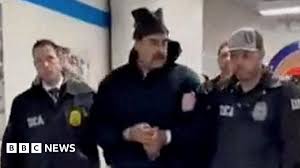
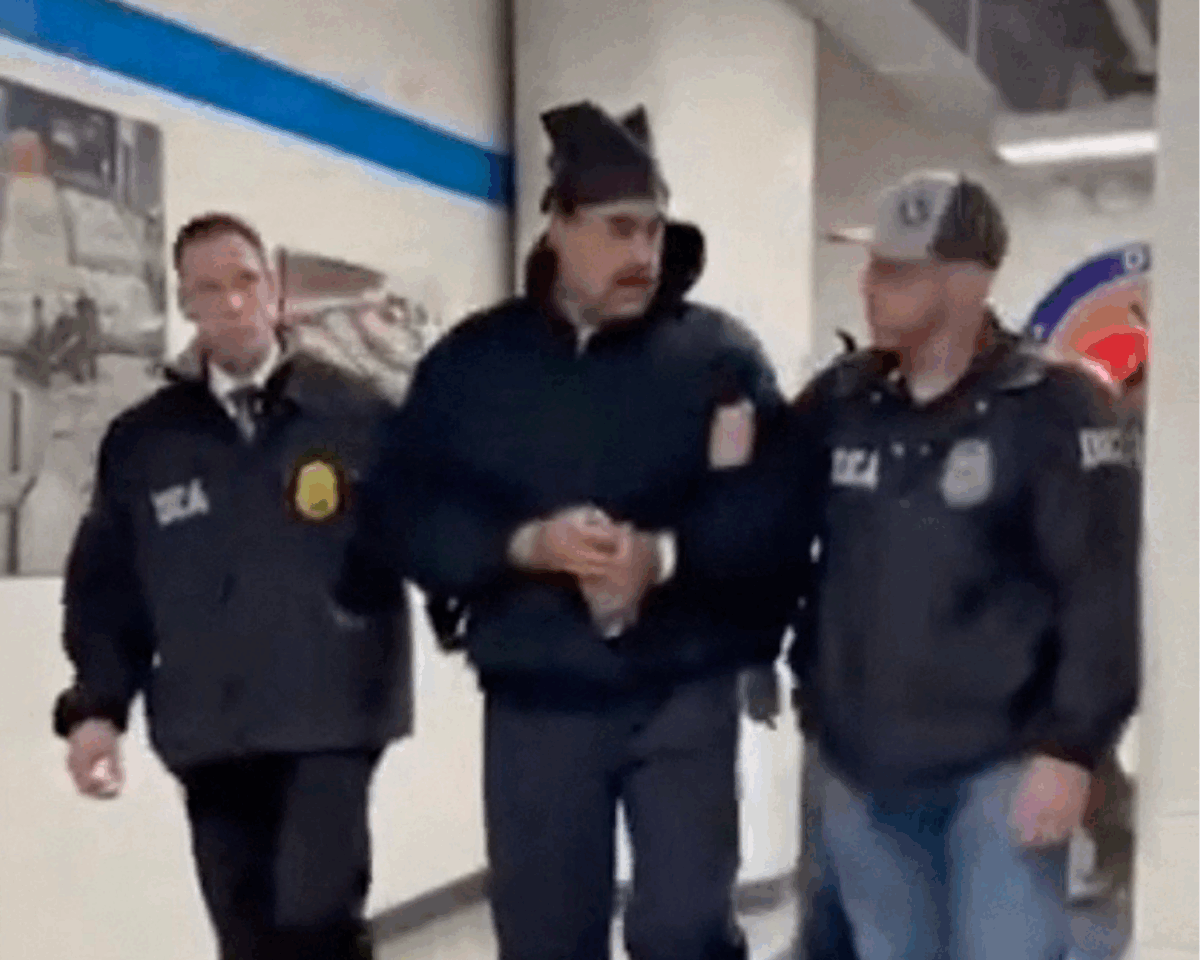
Venezuela’s toppled leader Nicolás Maduro and his
wife, Cilia Flores, were in detention in New York on Sunday, a day after U.S. special forces captured them from their capital city compound and President Donald Trump vowed the United States would ‘run’ the South American country until a democratic transition could occur.
Over the span of a few hours on Saturday, U.S. strikes targeted air defenses and other sites in Caracas and three other Venezuelan states, whisking away both Maduro and Flores and transporting them thousands of miles over sea and air to the United States.
The operation marked a dramatic escalation of Trump‘s stance toward Venezuela after months of rising tensions, threats and oil tanker seizures.
Maduro and his wife have been indicted on federal drug and weapons charges, and are expected to attend an arraignment in New York City as early as Monday, according to multiple media reports. As global reverberations continue to be felt, many questions remain unanswered, including those regarding the future of U.S.-Venezuela relations and how the South American nation will move forward.
Maduro rejected ‘generous’ US offers before capture, Rubio said
Secretary of State Marco Rubio said Maduro was given “very generous offers” before U.S. forces swooped into Venezuela to extract him.
“He could have left Venezuela as recently as a week and a half ago,” Rubio told NBC’s “Meet the Press” on Sunday. “There were opportunities for him to avoid all of this.”
The Trump administration had been seeking Maduro’s ouster for months. Though the United States hasn’t had a formal diplomatic relationship with Venezuela in years, special envoy Richard Grenell had been talking to Maduro, searching for a negotiated solution.
Maduro “has made a career out of not keeping deals and figuring out how to save himself by buying time,” Rubio said. “But President Trump was not going to fall into that trap.
How do Venezuelans feel about Maduro’s capture?
At home, Maduro’s allies were still in charge and have denounced their leader’s “kidnapping” as part of an imperialist oil grab.
Streets were far quieter than usual on Sunday as Venezuelans anxiously discussed what would come next. Some stocked up on essentials but many simply hunkered indoors.
“I’ve just taken the dog out and it feels like an abandoned city, people are shut inside,” said Alejandra Palencia, 35, a psychologist in the city of Maracay. “There is fear and uncertainty.”
Once one of the most prosperous nations in Latin America, Venezuela’s economy nosedived further under Maduro, sending about one in five Venezuelans abroad in one of the world’s biggest exoduses. They were largely jubilant at the exit of Maduro, whose security forces repeatedly crushed opposition protests.
Still, Maduro opponents in Venezuela have been wary of celebrating and security seemed, if anything, lighter than usual on Sunday. Despite the nervous mood, in some places cars were moving, bakeries and coffee shops were open, and joggers and cyclists were out like a normal Sunday morning.
“Yesterday I was very afraid to go out, but today I had to. This situation caught me without food and I need to figure things out. After all, Venezuelans are used to enduring fear,” said one single mother in a working class neighborhood in oil city Maracaibo, who bought rice, vegetables and tuna.
− Reuters
Who is running Venezuela?
Secretary of State Marco Rubio told NBC’s “Meet the Press” on Sunday that the American officials “expect to see changes in Venezuela, changes of all kinds – long-term, short-term – but the most immediate changes are the ones that are in the national interest of the United States.”
Rubio dodged answering host Kristen Welker’s direct question about who, precisely, is running the country in the wake of Maduro’s capture by U.S. forces.
Venezuelan Vice President Delcy Rodriguez assumed control of the country on Saturday following Maduro’s capture. Though Rodriguez denounced the U.S. operation as a “kidnapping,” Rubio suggested Venezuelan leadership would be more compliant to U.S. demands in the wake of Maduro’s ouster.
“We expect to see more compliance and cooperation than we were previously receiving,” he said on the show. “With Nicolas Maduro, you could not make a deal or an arrangement.”
In a Saturday news conference following the U.S. strike, Trump told reporters that “We’re going to run the country.” But Rubio clarified, “It’s not running it. It’s running policy.”
“We want Venezuela to move in a certain direction,” he said, “because not only do we think it’s good for the people of Venezuela; it’s in our national interest.”
Did anyone die in Venezuela attack?
No United States military members were killed during the Saturday strikes on Venezuelan military bases, Trump said.
Venezuelan Vice President Delcy Rodríguez said some civilians and members of the Venezuelan military were killed, but official numbers have not yet been released. The New York Times reported that at least 40 people were killed in the attack, based on a conversation with an anonymous senior Venezuelan official.
The United States carried out strikes on major military sites and critical infrastructure in Venezuela, including Fuerte Tiuna, the main military base in Caracas.
Catch up: Why did the US attack Venezuela?
The attack on Venezuela and subsequent capture of Maduro comes about a month after Trump designated the leader and his government allies a foreign terrorist organization.
The leader has since been indicted on charges of “narco-terrorism Conspiracy, cocaine importation conspiracy, possession of machineguns and destructive devices, and conspiracy to possess” the weapons, Attorney General Pam Bondi said in a post on X on Saturday.
Much of the strife stems from questions around the legitimacy of Maduro’s 2024 election and accusations against the Venezuelan president of trafficking drugs into the United States. Those accusations can be traced back to Trump’s first administration, when Maduro and over a dozen other Venezuelan officials were indicted by the United States in March 2020 for drug trafficking charges.
While speaking to Fox News on Saturday morning, Trump said the action in Venezuela was taken because drugs killed about 300,000 Americans each year. “We don’t lose that much in a war,” he said. “We are stopping drugs from coming into this country and nobody has been able to do it until we came along,” Trump said.
Where is Venezuela?
Venezuela is a Caribbean nation in the northernmost part of South America. It shares borders with Colombia, Brazil and Guyana.
Popular destinations in the Caribbean lie north of Venezuela, including Aruba, Curaçao, St. Lucia and Barbados and were among those affected by flight restrictions in the region during the U.S. strike on Venezuela that resulted in the capture of Maduro.
The country holds the world’s largest oil reserves.
Trump administration indictment includes Maduro’s son
Nicolás Maduro’s son Nicolás Maduro (Jr.) Guerra, 35, is listed in the indictment charging the Venezuelan leader with narco-terrorism. A member of Venezuela’s National Assembly, Guerra is also known as “Nicolasito” or “The Prince,” according to the court filing.
Born to his father’s first wife, Adriana Guerra Angulo in 1990, Guerra began assisting in drug operations as early as 2014, according to the indictment. A deputy in his father’s government, Guerra has been seen by many as a successor of the Chávismo movement, the socialistic ideology established by Venezuelan Pres. Hugo Chávez.
The indictment, signed by Jay Clayton, U.S. attorney for the Southern District of New York, describes Guerra’s involvement in a drug operation starting in 2014 during which his plane “would be loaded, sometimes with the assistance of armed sergeants, with large packages wrapped in tape that the captain understood were drugs.” Guerra helped ship “hundreds of kilograms of cocaine from Venezuela to Miami” in 2017,” the court filing says.
About 2020, Guerra met with two representatives of the FARC (Revolutionary Armed Forces of Colombia) in Medellin, Colombia to discuss “arrangements to move large quantities of cocaine and weapons through Colombia and into the United States over the course of the next six years,” the filing says.

World reacts to US bombing, capture of Venezuela’s Nicolás Maduro
Reactions to the United States’ bombing of Venezuela and capture of the country’s president Nicolás Maduro ranged across the world. See the moment.
Flights resume in the Caribbean, airlines waive fees
Airlines resumed flights in the Caribbean on Sunday after flight restrictions lifted overnight in the wake of a U.S. strike on Venezuela.
U.S. Transportation Secretary Sean Duffy said the restrictions expired at midnight, and major airlines announced they were resuming flights to and from 13 impacted airports. Hundreds of flights had been cancelled on Saturday out of Puerto Rico’s main airport.
Delta said in a statement it expects to operate its normal roster of Caribbean flights on Sunday, “with possible schedule adjustments as airline resources are repositioned.”
In a statement, American Airlines said “it’s all hands on deck” to move passengers in the region. The airline added some 3,700 seats on more than a dozen extra flights to and from San Juan, Puerto Rico, as well as Aruba, the U.S. and British Virgin Islands, Antigua, Barbados, Dominica and Barbados and its hubs in Miami and Charlotte, North Carolina.
United Airlines told USA TODAY it expected to operate most scheduled flights in the region on Jan. 4. The airline is also working to add new flights for travelers whose travel was disrupted.
All the major airlines issued travel waivers to passengers affected by the cancellations, waiving some rebooking fees.
FlightAware.com showed 17 cancellations on Jan. 4 into and out of San Juan’s Luis Muñoz Marin International, compared with more than 400 a day earlier.
China, North Korea call on US to respect Venezuela’s sovereignty
Chinese officials condemned the United States for capturing Maduro and Flores in a statement published online on Sunday, calling it a “clear violation of international law.”
“China calls on the U.S. to ensure the personal safety of President Nicolás Maduro and his wife, release them at once, stop toppling the government of Venezuela, and resolve issues through dialogue and negotiation,” the statement said.
North Korea, another major adversary of the United States, urged “all relevant parties” to “ease tensions in the region,” and restore democracy “with due respect for the will of the Venezuelan people.”

Jesus Linares, 48, stands next to a local resident as he looks at his damaged apartment building, after the U.S. launched a strike on Venezuela, … Show more
What happens now in Venezuela?
Gunfire in the streets of a Latin American capital. U.S. military troops swooping in by helicopter. A foreign leader, accused of drug trafficking, hauled off to America in handcuffs.
The Trump administration’s Jan. 3 capture of President Nicolás Maduro bore some familiar echoes to the 1989 U.S. invasion of Panama that ousted military strongman Manuel Noriega — and marked the most direct U.S. intervention in Latin America since.
But experts say that despite some similarities, the two key moments in America’s long and checkered history of interventions differ in major ways that could make achieving U.S. goals more challenging this time following a raid that has revived regional anxiety.
− Chris Kenning
Read more here: What’s next in Venezuela? Panama raid that ousted Noriega offers clues.

Trump: ‘We are going to run’ Venezuela until transition
Hours after his administration struck Venezuela and deposed its president, Trump said at a Saturday news conference that the U.S. plans to run the country until a transition in leadership can take place.
“We’re going to run the country until such time as we can do a safe, proper and judicious transition,” Trump said.
Trump said, “It has to be judicious, because that’s what we are all about.”
The president did not immediately provide additional details on how the U.S. planned to manage the sovereign nation.
During an interview on Fox News’ “Fox & Friends” earlier in the day, Trump declined to say whether he would back Venezuelan opposition leader Maria Corina Machado, the winner of the 2025 Nobel Peace Prize, for the presidency.
−Francesca Chambers
Maduro’s journey to NY: Ships, planes and helicopters
Maduro and Flores landed in Brooklyn before heading to the Metropolitan Detention Center the evening of Jan. 3.
By then, they had been on multiple types of aircraft, plus a massive warship, in a journey spanning at least three nations and two time zones.
After the couple was taken from their Caracas home, they were loaded onto a helicopter, where the raid force had to fight its way out of Venezuelan airspace, according to Chairman of the Joint Chiefs of Staff. Gen. Dan “Razin” Caine.
More: ‘A lot of gunfire’: Here’s how the US raid to capture Maduro unfolded
They were then loaded onto the USS Iwo Jima, a U.S. Navy amphibious assault ship, and sailed across the Caribbean Sea to the U.S military base in Guantanamo Bay, Cuba.
Next, they were transferred to a plane to fly the final stretch to New York, landing shortly before sunset Eastern time at Stewart Air National Guard Base about 50 miles north of Manhattan. Once embarked, they were placed in helicopters and flown to Westside Heliport in Manhattan, then finally on to the Brooklyn detention facility.

President Donald Trump and Venezuela’s President Nicolas Maduro
MANDEL NGAN,FEDERICO PARRA, AFP via Getty Images