The president said early Saturday that the U.S. carried out a large-scale strike against Venezuela and captured the country’s leader.
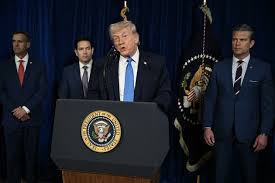
President Donald Trump speaks to the press following U.S. military actions in Venezuela at his Mar-a-Lago residence in Palm Beach, Florida, on Jan. 3, 2025. | Jim Watson/AFP via Getty Images
The United States will “run” Venezuela until a leadership transition is able to take place, President Donald Trump said Saturday, hours after the U.S. military ousted Venezuelan President Nicolas Maduro.
“We’re going to run the country until such time as we can do a safe, proper and judicious transition,” Trump said during a press conference at Mar-a-Lago. “We don’t want to be involved with having somebody else get in and have the same situation that we had for the last long period of years.”
Trump provided few details of how the U.S. would lead the Latin American country, other than it would be a “group” likely including Secretary of State Marco Rubio, Secretary of Defense Pete Hegseth and Joint Chiefs Chair Dan Caine.
Trump also hinted at the possibility of American troops being stationed in Venezuela, saying the U.S. is “not afraid of boots on the ground.”
“We’re ready to go again if we have to. We’re going to run the country right,” the president said.
His comments came after the U.S. staged an overnight raid of Venezuela, capturing Maduro, and his wife, Cilia Flores, who are now en route to New York to face trial for several charges, including narco-terrorism conspiracy and cocaine importation conspiracy against the U.S.
Trump described the attack as “an assault like people have not seen since World War II,” adding that it was “one of the most stunning, effective and powerful displays of American military competence in American history.”
During the operation, which Caine designated as “Absolute Resolve,” the lights of Caracas, Venezuela’s capital, were “largely turned off due to the expertise that we have,” the president said. Caine said that more than 150 U.S. aircrafts were launched from 20 bases toward Venezuela as part of the operation.
A fire at Fuerte Tiuna, Venezuela’s largest military complex, is seen from a distance after a series of explosions in Caracas, Venezula, on Jan. 3, 2026. | AFP via Getty Images
The dramatic turn of events caps a monthslong pressure campaign by the Trump administration against Venezuela, which began in September with military strikes in the Caribbean Sea to kill alleged drug traffickers on boats. At that time, Trump said the U.S. was focused on stopping the flow of drugs and “not talking about” regime change, a point that drew skepticism from Democrats as well as conservative MAGA voices who oppose foreign intervention by the U.S.
“We did a great job. We’re stopping drugs from coming into this country,” Trump said, a point his closest allies repeated Saturday in defense of the raid.
Trump on Saturday signaled that the U.S. could expand its focus to other Latin American countries.
Trump rechristened the Monroe Doctrine — former President James Monroe’s policy initiated in the 1820s declaring the Western Hemisphere to be under the U.S.’s influence, warning against new European colonization in Latin America — as the “Donroe Doctrine,” when detailing how Venezuela invited outside powers like China and Russia into America’s backyard.
“The Monroe Doctrine is a big deal. But we’ve superseded it by a lot. They now call it the ‘Donroe Doctrine,’” he said.
Trump singled out Cuba and Colombia during his press conference. “I think Cuba is going to be something we’ll end up talking about,” Trump said when asked if he had a message for the nation’s president, Miguel Diaz-Canel. “Cuba is a failing nation. It’s very similar” to Venezuela, he added.
Trump also challenged Colombian President Gustavo Petro, whom he has long vocalized his disagreements with, saying the Latin American leader should “watch his ass” following the operation in Venezuela. “He’s making cocaine and they’re sending it to the United States, so he does have to watch his ass.”
In an interview with Fox News Saturday morning before his press conference, Trump said Maduro hoped to negotiate in the final days before U.S. forces captured him, and that the two men had spoken.
“He wanted to negotiate at the end and I didn’t want to negotiate,” Trump said, adding that he told Maduro he had to “give up” and it was “close, but in the end … we had to do something that was much more surgical, much more powerful.”
The overnight raid stunned other global leaders, who responded with a mix of condemnation — particularly from those in the region — and some praise from allies.