

The 6-3 ruling comes more than two months after the Trump admin asked the justices to weigh in on the move.

The Supreme Court has rebuffed President Donald Trump’s attempt to deploy National Guard troops in Illinois to protect federal officials carrying out his mass-deportation policy.
In their ruling Tuesday, the justices noted that federal law generally bars use of the military for law enforcement, and they declared that the law Trump used to activate the Guard is likely to apply only when regular armed forces — the Army, Navy, Air Force and Marines — are insufficient to maintain order.
“At this preliminary stage, the Government has failed to identify a source of authority that would allow the military to execute the laws in Illinois,” the high court said in an unsigned order released more than two months after the administration asked the justices to weigh in.
Three conservative justices — Clarence Thomas, Samuel Alito and Neil Gorsuch — dissented, while another conservative, Brett Kavanaugh, voted to deny Trump’s request but declined to join the majority’s explanation of the ruling.
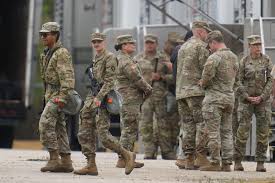
The Supreme Court’s decision turned down the administration’s bid to lift lower court orders that halted the president’s plan to use 500 National Guard soldiers from Illinois and Texas to respond to protests and unrest at an Immigration and Customs Enforcement facility in suburban Chicago.
The ruling is a rare loss for the president following a string of wins he has racked up on the high court’s emergency docket in the first year of his second term. The justices cleared the way for him to fire leaders of federal agencies, dismiss tens of thousands of government employees and halt thousands of federal grants and contracts, while turning aside the Justice Department’s emergency requests on only a few occasions.
And while the latest decision is not a final one on the legal issues at stake in the National Guard deployments, it is a significant setback for the president in a battle with Democratic leaders who have taken legal action to resist his efforts to advance his immigration agenda by putting federalized troops on the streets in several major cities.
Trump’s attempt to deploy the National Guard to Illinois in September followed similar moves he made earlier this year in Los Angeles and Portland, Oregon.
Federal appeals judges initially sided with the president over the Southern California deployment, but later allowed a lower-court order blocking further use of the troops to remain in place. A district court judge’s order halting the use of Guard troops in Oregon also remains in effect.
District and appeals court judges have also sharply rejected Trump’s bid to borrow National Guard troops from cooperative red states and send them into Democratic-led cities and states over the objection of governors and mayors. But the Supreme Court didn’t weigh in on that question.
Alito, joined by Thomas, sharply criticized his colleagues in his dissent for weighing in on the “regular forces” issue even though it wasn’t litigated in the lower courts. Alito also lamented at length attacks on immigration officials and said lower courts were not deferential enough to Trump’s conclusion that the Guard was needed.
“There is no basis for rejecting the President’s determination that he was unable to execute the federal immigration laws using the civilian law enforcement resources at his command,” Alito wrote. “I have serious doubts about the correctness of the Court’s views. And I strongly disagree with the manner in which the Court has disposed of this application.”
Alito also suggested that the National Guard may be exempt from the federal law — the Posse Comitatus Act — that bars the military from performing domestic law enforcement. He acknowledged the nation’s historic reluctance to use soldiers as “domestic police,” but said Americans have been more comfortable with using troops to protect federal property and personnel, a mission he described as closely related to executive federal laws.
Gorsuch wrote separately, indicating he agreed with much of Alito’s opinion and would have allowed the Guard deployment in Illinois pending further litigation.
Kavanaugh indicated he had enough doubts about the administration’s legal arguments that he agreed with denying the emergency stay the federal government sought, but he also said he thought the majority went too far in hashing out the legal issues involved in the case.
“One apparent ramification of the Court’s opinion is that it could cause the President to use the U.S. military more than the National Guard to protect federal personnel and property in the United States,” the Trump appointee wrote.
The Democratic governors and attorneys general of Illinois, California and Oregon opposed the deployments and sued to stop them. They argued that the troops were unnecessary, untrained for such missions and more likely to inflame the situation than calm it.
Illinois Gov. JB Pritzker hailed the high court’s decision Tuesday.
“Today is a big win for Illinois and American democracy,” Pritzker said in a statement. “This is an important step in curbing the Trump Administration’s consistent abuse of power and slowing Trump’s march toward authoritarianism.”
During the court challenges, Trump administration lawyers contended that federal law enforcement personnel were overstretched by protests and that the National Guard would provide relief to the Federal Protective Service and others attempting to secure federal office buildings and courthouses. DOJ attorneys also said the troops might be called on to protect ICE personnel in the field.
In the emergency appeal filed with the high court Oct.17, Solicitor General D. John Sauer argued that Trump’s determination that the military forces were required should not be second-guessed by federal judges. “The President was entitled to conclude that much enforcement has been thwarted, and that what remains has come at an unacceptable risk to the safety of federal officers,” Sauer wrote.
U.S. District Judge April Perry, a Biden appointee, blocked the deployment in Illinois in October. She said the protests had been “mostly peaceful” and there was no proof of a need for troops.
“I have seen no critical evidence that there is a danger of rebellion in the state of Illinois,” Perry said.
White House spokesperson Abigail Jackson said the ruling wouldn’t have a significant impact on Trump’s mass-deportation drive.
“The President promised the American people he would work tirelessly to enforce our immigration laws and protect federal personnel from violent rioters,” Jackson said in a statement. “Nothing in today’s ruling detracts from that core agenda.”
Source:politico.com
Source